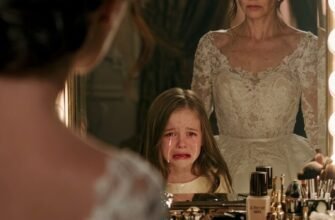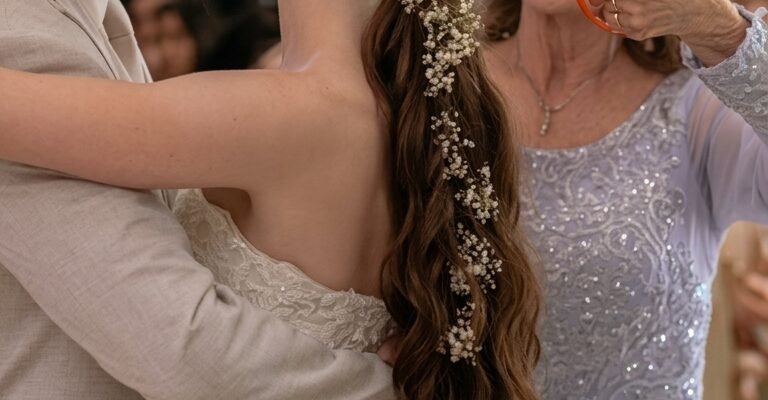
The person standing before the bride was a woman in her late fifties, wearing a simple black dress. Her silver hair fell over her shoulders, and a long scar was visible near her hairline.
The groom’s mother, Margaret, staggered backward.
“Elizabeth?” she whispered. “But you’re d.e αd!”
The stranger stepped into the wedding hall.
“No, Margaret. You just made everyone believe I was.”
The groom, Daniel, lowered his microphone.
“Mom, meet the woman you told me was my father’s first wife.”
Margaret shook her head desperately.
“Daniel, you don’t understand. She’s d.a חgerous!”
Elizabeth looked at the long ponytail still clutched in Margaret’s hand.
“Still cutting brides’ hair, I see.”
The bride, Emily, stood beside Daniel, wiping tears from her cheeks.
“What does any of this have to do with my hair?”
Elizabeth approached her gently.
“Twenty-five years ago, I stood in your exact place. I married into this family, and Margaret cut off my hair during the reception.”
Emily touched the uneven ends of her own hair.
“She told me it was a family tradition.”
“That’s what she told me, too.”
Elizabeth reached into her handbag and removed an old photograph.
It showed a young bride crying beside a wedding cake. Behind her stood Margaret, smiling and holding a pair of orange-handled scissors.
Daniel stared at the picture.
“Why would you do this to someone, Mom?”
Margaret’s expression hardened.
“Women who join this family must learn respect.”
Elizabeth shook her head.
“No. That’s what you wanted us to believe.”
She placed another photograph on the table.
This one showed a small wooden box filled with locks of hair, each tied with a ribbon and labeled with a woman’s name.
Emily felt sick.
“You kept them?”
Margaret said nothing.
Elizabeth continued.
“Margaret collected hair from every bride who married into the family. She told us it was a blessing. But the hair wasn’t the real purpose.”
Daniel frowned.
“What was?”
“Hu.m ìliation. Control. She wanted every new wife to understand that she could take something precious from her whenever she wished.”
Margaret suddenly shouted, “That’s enough!”
But Elizabeth wasn’t finished.
“When I refused to obey her, she accused me of stealing family jewelry. She forged letters, turned my husband against me, and forced me out of the house.”
Daniel looked stunned.
“My father told me you disappeared with another man.”
“Because Margaret convinced him of it.”
Elizabeth took out a yellowed envelope.
Inside were copies of the forged letters and a statement from a former household employee who had witnessed Margaret planting the missing jewelry in Elizabeth’s suitcase.
Daniel read the documents in silence.
His mother had spent decades portraying Elizabeth as a c.r ∪el, dishonest woman.
Now the truth was unfolding in front of everyone.
“Why did Dad never tell me?” Daniel asked.
Elizabeth’s eyes filled with tears.
“Because he learned the truth too late. He tried to find me before he d.i ℮d, but Margaret intercepted his letters.”
Margaret backed toward the exit.
“You have no right to come here and destroy my family!”
Daniel stepped in front of her.
“No, Mom. You destroyed people’s lives because you couldn’t stand losing control.”
Emily finally found her voice.
“And today you tried to hu.m ìliate me in front of everyone I love.”
Margaret glanced at the severed ponytail in her hand.
For the first time, she seemed to realize that nobody was defending her.
She slowly placed the hair on a nearby table.
“I only wanted to protect our family traditions,” she murmured.
Daniel shook his head.
“Ab.u śe isn’t a tradition.”
He turned toward Emily.
“I’m sorry I didn’t see what she was planning. I should have protected you.”
Emily looked at him.
“Then promise me something. No woman who enters this family will ever be treated this way again.”
“I promise.”
Daniel asked the venue staff to escort his mother out. Margaret left without another word.
The wedding guests remained silent until Elizabeth approached Emily.
“I’m sorry your wedding became the day this secret came out.”
Emily managed a small smile.
“Maybe it needed to.”
She picked up her severed ponytail and looked at it for a moment.
Then she set it down.
“She took my hair,” Emily said, “but she doesn’t get to take my happiness.”
Daniel reached for her hand.
The musicians slowly began playing again.
And this time, when the newlyweds returned to the dance floor, nobody stood behind the bride with a pair of scissors.
Months later, Emily donated her long hair to an organization that made wigs for people experiencing medical hair loss. She chose to turn a hu.m ìliating moment into something meaningful.
Elizabeth became a welcome guest in Daniel and Emily’s home, finally able to tell her story without fear.
As for Margaret, the family stopped inviting her to celebrations until she could acknowledge the h.a ŕm she had caused.
The old box of labeled locks of hair was eventually discovered in her attic, just as Elizabeth had described.
Daniel arranged for the women whose names appeared on the ribbons to be contacted.
Some wanted their hair returned. Others wanted the box dest.r σyed.
For the first time, each woman was allowed to decide for herself.
And that became the only family tradition Emily wanted to pass on:
Respect isn’t something you demand by taking from others. It’s something you earn by treating them with dignity.